How the Three Pillars of TRSP Work Together
The three pillars of TRSP connect standards, authority and accountability into one practical framework for reviewing and overseeing large-impact projects.


Part Two of Understanding the Texas Resource Stewardship Protocol
A strong public process needs more than a list of concerns.
It needs standards that tell everyone what responsible operation should look like.
It needs authority and technical support so those standards can be applied fairly.
It needs monitoring and enforcement so the public can know whether the commitments made before approval are being kept afterward.
That is why the Texas Resource Stewardship Protocol is built on three connected pillars.
Set the standards.
Provide the authority.
Verify the results.
Each pillar has a different job. None of them is complete by itself.
Together, they create a practical path from the first project proposal to long-term operation.
Why three pillars are needed
Large-impact projects can bring investment, jobs and new infrastructure.
They can also place significant demands on water, roads, emergency services and the surrounding community.
A county may be asked to approve a tax abatement, support a reinvestment zone, sign a road-use agreement or provide another form of discretionary public support before the full local impact is known.
At that point, several different questions need answers:
- What standards should the project be expected to meet?
- What evidence should be reviewed before public support is granted?
- What authority does the county have to require information or conditions?
- Who pays for the technical review?
- How will the public know whether the project continues to operate as promised?
- What happens when a measurable commitment is missed?
One policy cannot answer all of those questions by itself.
The three-pillar structure separates the work into clear parts while keeping those parts connected.
Pillar One: Set the standards
The first pillar is the Good Neighbor Policy.
Its purpose is to establish local expectations before a county grants discretionary public support to a large-impact project.
The Good Neighbor Policy asks the county to define what information should be submitted, what impacts should be reviewed and what standards should guide the decision.
Depending on the project, that review may include:
- Water source, demand, conservation and drought planning.
- Noise, vibration and low-frequency sound.
- Lighting and dark-sky protection.
- Roads, traffic and construction impacts.
- Drainage, runoff and erosion controls.
- Emergency readiness and response planning.
- Financial assurance, continuing reports and corrective-action commitments.
The Good Neighbor Policy also establishes review triggers.
Not every business expansion needs the same level of review. The process should focus on projects whose scale, resource demand, public support request or potential cross-boundary effects justify closer examination.
Pillar One therefore answers the first set of questions:
- What should the project prove?
- What standards should it meet?
- What should be included in the public record before a decision is made?
The Good Neighbor Policy gives the county a repeatable local process instead of forcing officials and residents to invent one after each new proposal arrives.
But a county policy can only operate within the authority Texas law provides.
That leads to Pillar Two.
Pillar Two: Provide the authority
The second pillar is the Texas Resource Stewardship Initiative.
It addresses the gap between the responsibilities rural counties are being asked to carry and the authority or technical capacity they currently possess.
A county can adopt procedures for its own discretionary decisions.
It cannot create powers the Legislature has not granted.
The Texas Resource Stewardship Initiative identifies the tools that may require state action, including:
- Clear statewide standards and review triggers.
- Narrow county authority to review qualifying large-impact projects.
- Applicant-funded independent technical review selected and directed by the public body.
- Resource-protection tools for counties without specialized local authorities.
- Authority to place measurable conditions into enforceable agreements.
- Defined roles for monitoring, local verification and escalation after approval.
Pillar Two does not propose general countywide zoning.
It does not make a county the replacement for state agencies, municipalities, groundwater conservation districts or other bodies with existing jurisdiction.
It is focused on a narrower question:
When a large-impact project asks a county for public support or creates significant local demands, what practical authority and technical support should the county have to review the evidence and protect shared resources?
Pillar Two makes the standards in Pillar One more than an advisory list.
It creates the legal and technical bridge needed to apply them consistently.
But standards and authority still do not show what happens after approval.
That is the role of Pillar Three.
Pillar Three: Verify the results
The third pillar is Industrial Monitoring and Enforcement.
It begins where approval leaves off.
A project may agree to limits on water use, noise, lighting, road impacts, drainage or other operating conditions.
Those commitments have little public value when no one can determine whether they are being met.
Industrial Monitoring and Enforcement turns promises into measurable operating requirements.
It asks:
- What will be measured?
- How often will the information be collected?
- Who receives an alert when a threshold is crossed?
- How will a complaint be investigated?
- Who verifies the technical evidence?
- What corrective action is required?
- How will the public record show whether the correction worked?
Monitoring should fit the risk.
Some conditions may be reviewed through periodic reports, certified records or scheduled inspections.
Others may justify continuous or near-continuous monitoring because the impact can change quickly or an emergency alert cannot wait for the next monthly report.
The project should fund the reasonable equipment, data systems and trained operational response associated with its activities.
Applicant-funded does not mean applicant-controlled.
Independent reviewers should remain responsible to the public process, and county officials should receive the records and alerts needed for verification, oversight and escalation.
Public dashboards can make the results understandable without requiring residents to become technical specialists.
The public should be able to see current status, recent trends, missed reports, open problems, corrective actions and the records supporting those conclusions.
Pillar Three answers the continuing question:
Is the project operating as promised, and what happens when it is not?
How the three pillars move a project through the process
The easiest way to understand TRSP is to follow a project from proposal through operation.
The graphic below shows how the three pillars guide a large-impact project from request to accountability.
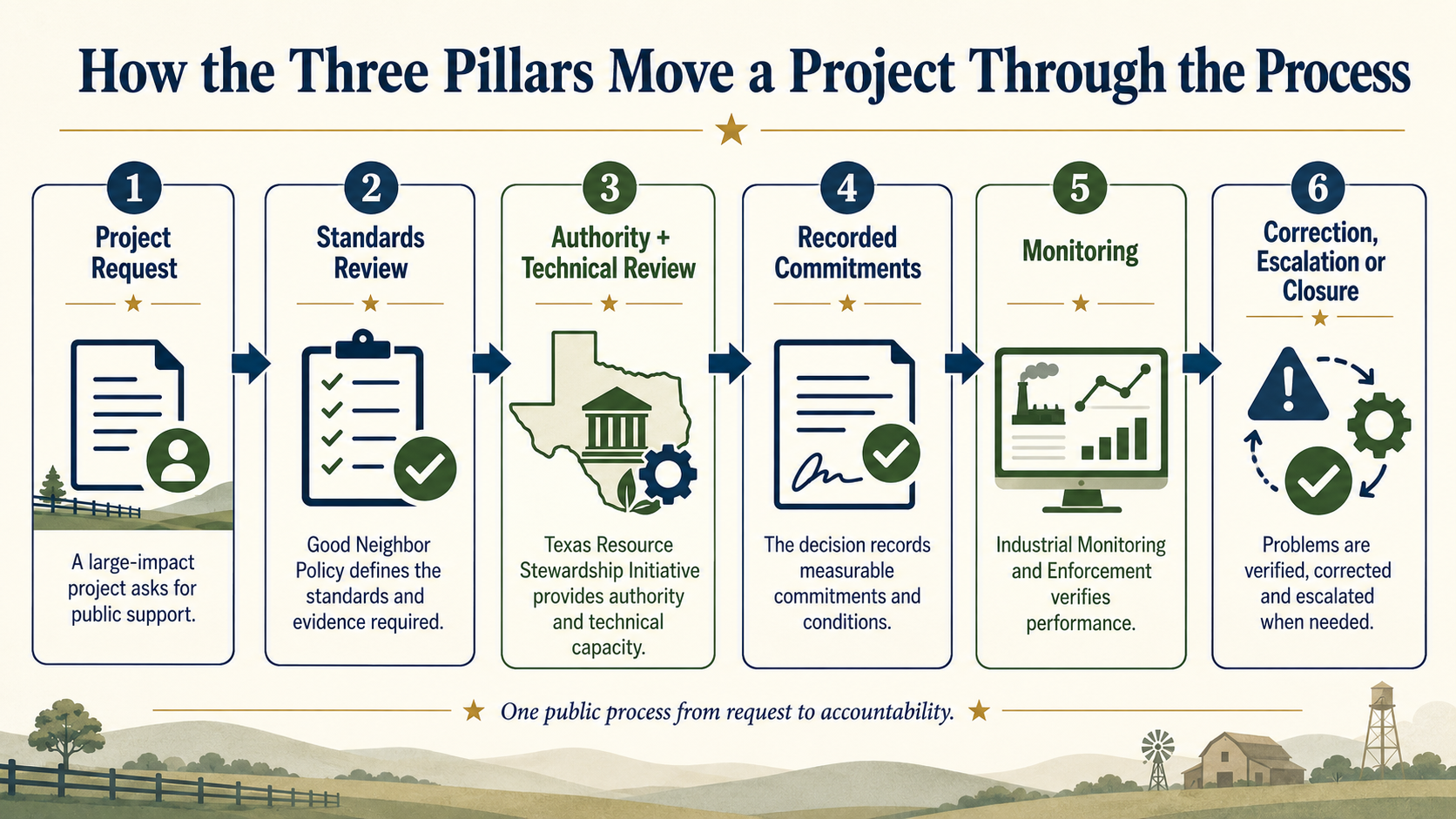
The numbered steps below explain each stage in more detail.
1. A project asks for public support
A developer proposes a large-impact project and asks the county for a tax abatement, project agreement, road commitment, support letter or another discretionary action.
The request triggers the Good Neighbor Policy review when the project meets the applicable threshold.
2. The standards define the evidence needed
Pillar One identifies the subjects that must be addressed and the standards the project should meet.
The applicant submits information on water, roads, noise, drainage, emergency planning and other relevant impacts.
The public record begins before the decision is made.
3. Authority and technical support make review possible
Pillar Two provides the legal framework and technical capacity needed to examine the evidence.
Qualified reviewers evaluate the material where specialized expertise is required.
The county can identify missing information, unresolved risks or conditions needed before public support is granted.
4. The decision includes measurable commitments
When the project meets the standards or reaches an acceptable agreement, the commitments are written clearly enough to be monitored later.
The decision should identify limits, reporting duties, monitoring methods, correction procedures and consequences for continued noncompliance.
5. Monitoring begins with operation
Pillar Three carries those commitments into the operating life of the project.
Reports, sensors, inspections, complaints and public records show whether the project remains within the agreed limits.
6. Problems move through a defined response
When a possible problem is detected, the process does not begin with rumor or improvisation.
It begins with a known sequence:
- Detect or receive the complaint.
- Acknowledge and review it.
- Verify the evidence.
- Require corrective action.
- Retest and confirm the result.
- Close the public record or escalate enforcement.
The same framework that helps identify a problem also gives a responsible operator a fair way to correct it and demonstrate that the correction worked.
The pillars form a continuing loop
TRSP is not only a straight line from proposal to approval.
It is also a continuing learning system.
Monitoring may show that a standard is working as intended.
It may reveal that a threshold needs refinement, a monitoring location is inadequate or a new operating condition was not anticipated during the original review.
Material changes in equipment, ownership, water demand or operating hours may require supplemental review.
Lessons from one project can improve the Good Neighbor Policy and statewide framework used for the next one.
The process therefore forms a loop:
- Set the standards.
- Review the evidence.
- Record the commitments.
- Monitor the results.
- Correct the problems.
- Improve the standards.
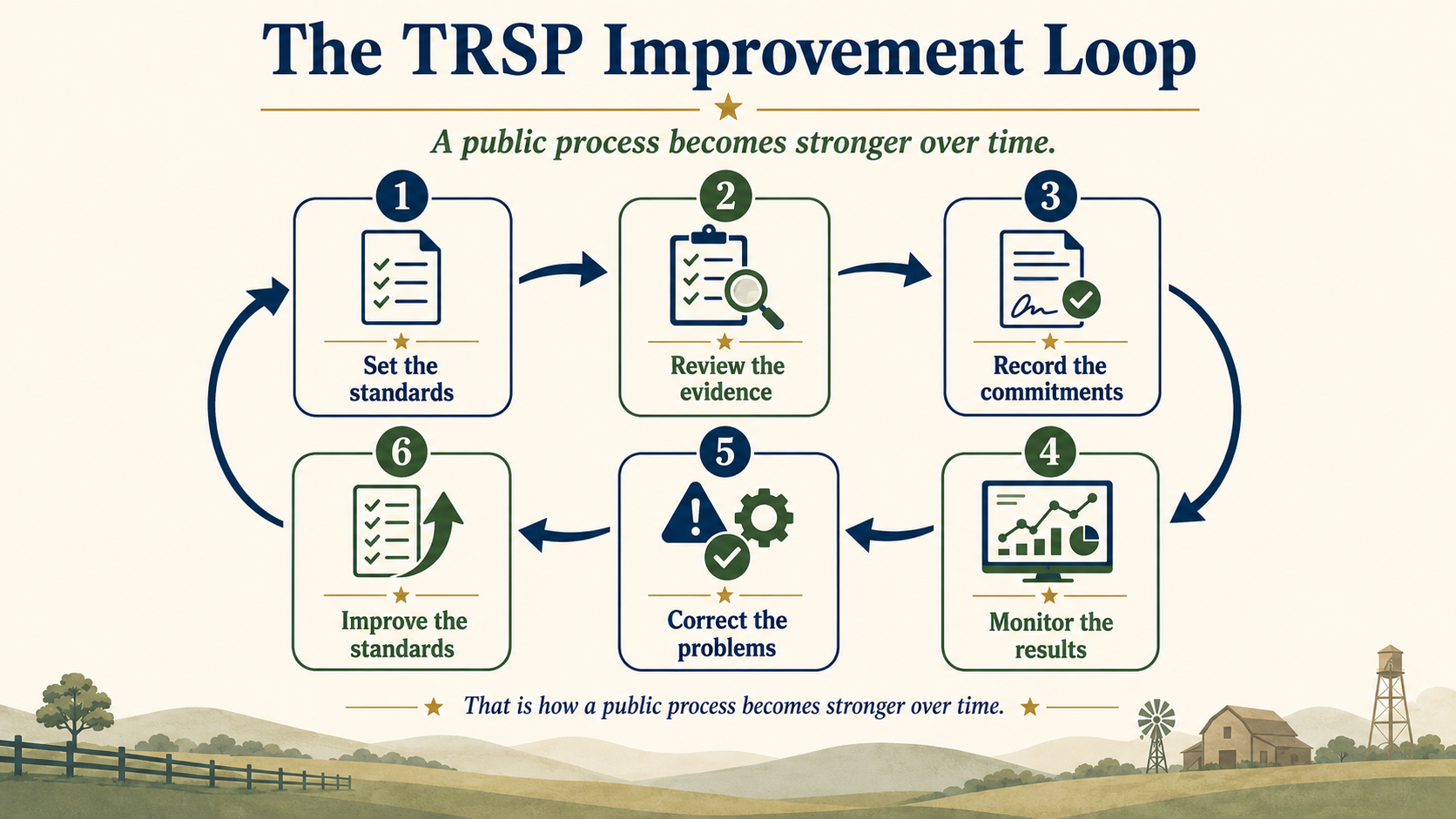
That is how a public process becomes stronger over time.
What happens when one pillar is missing
The three pillars are designed to prevent three common failures.
Standards without authority
A county may identify good practices but lack the authority, funding or technical support needed to require evidence or verify whether the practices are followed.
The standards become recommendations instead of a working review system.
Authority without standards
A county may receive new authority but have no clear process for deciding when to use it, what evidence to request or what outcome it is trying to achieve.
The review becomes inconsistent and unpredictable for both residents and developers.
Monitoring without enforcement
A dashboard may collect large amounts of data, but the information changes nothing when alerts, corrective action and escalation are not defined.
The result is observation without accountability.
TRSP connects all three:
- Standards tell the project what responsible operation requires.
- Authority makes fair review and enforceable commitments possible.
- Monitoring shows whether those commitments are being kept and starts the response when they are not.
A framework for responsible growth
The Texas Resource Stewardship Protocol is not an automatic approval system.
It is not an automatic rejection system.
It is a process for making better public decisions.
Responsible development should be able to show its work.
The applicant should know what information is expected.
County officials should have standards, authority and qualified support.
Residents should be able to follow the evidence before and after the decision.
Responsible operators should have a clear way to demonstrate that they are meeting their commitments.
When problems occur, the process should identify them, verify the facts and produce correction so large-impact projects can operate as good neighbors to the communities around them.
The three pillars create that complete chain:
- Pillar One sets the standards.
- Pillar Two provides the authority.
- Pillar Three verifies the results.
Shared resources require all three.
Continue exploring
Read Pillar One: The Good Neighbor Policy:
https://www.skewthefuture.com/good-neighbor-policy-local-standards-before-public-support/
Read Pillar Two: The Texas Resource Stewardship Initiative:
https://www.skewthefuture.com/pillar-two-texas-resource-stewardship-initiative/
Read Pillar Three: Industrial Monitoring and Enforcement:
https://www.skewthefuture.com/pillar-three-industrial-monitoring-enforcement/
Return to TRSP in Plain Language:
https://www.skewthefuture.com/the-texas-resource-stewardship-protocol-in-plain-language/
Explore the full Texas Resource Stewardship Protocol:
https://www.skewthefuture.com/trsp/
A question for the Front Porch
Which part of the process is most often missing when a large-impact project comes before a rural county: clear standards, practical authority or continuing accountability after approval?
Join the conversation in The Front Porch on Facebook.
Let's keep building.
Shared Resources. Shared Standards. Shared Stewardship.