Jack County Responds to New Budget Transparency Requirements
Jack County has posted its September 28 agenda and 50-856 tax-rate records. The agenda sets a 10 a.m. public hearing on the proposed budget and tax rate. Here is what is now online, what we have not located and what taxpayers can review before Monday.

Jack County has now posted its September 28 meeting notice and the 50-856 tax-rate records. The agenda sets a 10 a.m. public hearing on the proposed county budget and tax rate, while some HB 1522 materials remain difficult to locate online.
Jack County’s budget process is beginning to look different.
During Friday’s Commissioners Court budget workshop, county officials discussed several changes aimed at meeting new state budget-notice requirements and making the documents behind the tax-rate decision easier for the public to find.
I attended the September 18 workshop and followed the discussion as officials worked through the new requirements.
The changes discussed included making the proposed budget clearly accessible from the County homepage, creating a budget page that can become part of a permanent archive, developing the taxpayer-impact statement required by House Bill 1522 and publishing the Form 50-856 tax-rate worksheets with the records supporting the calculations.
Since Friday, part of that plan has been implemented. The County has posted the 2026 Jack County and Jack County Special Form 50-856 packages and supporting records, and the links are working. The September 28 agenda is also now posted. It sets a 10 a.m. public hearing on the proposed county budget and tax rate, followed by separate agenda items to adopt the FY 2026-2027 budget and the 2027 county tax rate.
What HB 1522 changed
House Bill 1522 took effect September 1, 2025 and changed the notice requirements in the Texas Open Meetings Act.
For a meeting at which a governmental body will discuss or adopt its budget, Government Code §551.043 now requires the meeting notice to include a physical copy of the proposed budget unless the proposed budget has been made clearly accessible from the home page of the governmental body’s website.
The notice must also include a taxpayer-impact statement for the median-valued homestead.
That statement compares three numbers:
- the property-tax bill for the median-valued homestead in the current fiscal year;
- the estimated tax bill for that same property in the upcoming fiscal year if the proposed budget is adopted; and
- the estimated tax bill if the County instead adopts a balanced budget funded at the no-new-revenue tax rate.
The law does not tell taxpayers which of those choices they should prefer. It puts the alternatives beside each other so the public can see the dollar impact before the budget decision is made.
HB 1522 also changed the general Open Meetings Act posting period from 72 hours before a meeting to at least three business days before the scheduled date of the meeting.
The Texas Association of Counties recommends calculating that period conservatively. For a Monday, September 28 meeting, that guidance makes Tuesday, September 22 the conservative posting date, allowing Wednesday, Thursday and Friday as the three business days before the meeting.
A clearer path to the proposed budget
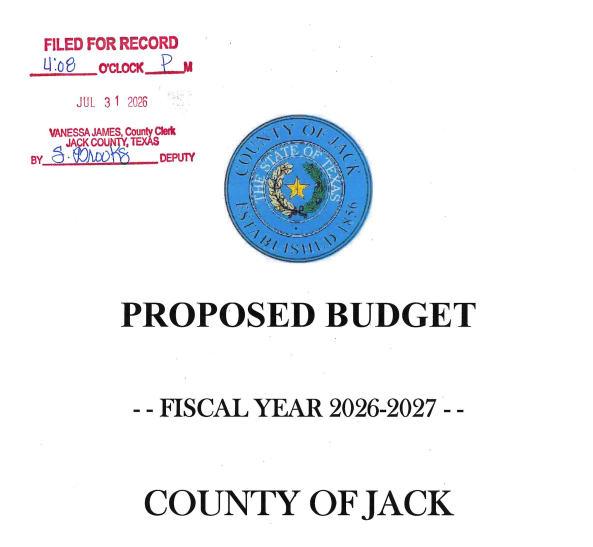
Jack County already has a Proposed Budgets page on its website. Friday’s discussion focused on making the current proposed budget clearly accessible from the County homepage and building a more useful structure around it.
As of Tuesday evening, the County homepage still did not show a clearly identifiable link to the current proposed budget. The Proposed Budgets page remained available, but it showed the same FY 2026-2027 budget file that had been available earlier in the process.
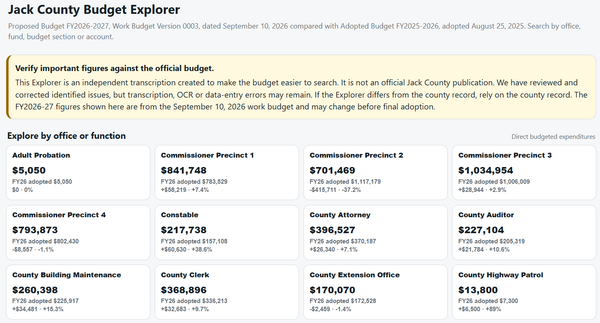
A later working budget also exists. The copy Jack County emailed to Skew the Future on September 14 includes pages dated September 10 and labeled Work Budget Version 0003. We have not located that version on the County website.
Judge Brian Keith Umphress described a plan for a FY 2026-2027 budget page that could later become part of the County’s budget archive. He also discussed eventually placing the documents used during budget workshops on that page so residents can see the material Commissioners are working from as the process develops.
The Judge said he had directed staff to look at the approach used by Brazos County as a model for implementing the new requirements.
Some of the website work has also been delayed by staffing availability. Emergency Management Coordinator / IT Director Frank Hefner was on a well-deserved vacation last week and is needed for some of the website changes discussed Friday.
That context does not change what the new law requires. It does help explain why officials were discussing both immediate changes for this budget cycle and a longer-term system for future years.
The taxpayer-impact statement is a different document
One of the most important parts of Friday’s discussion involved the taxpayer-impact statement.
The tax notice already associated with the County’s tax-rate process contains a comparison based on an average homestead value. HB 1522 requires something different for a budget-meeting notice: a comparison based on the median-valued homestead.
County staff discussed obtaining the required calculation through the tax software and posting the taxpayer-impact statement separately. As of Tuesday evening, I had not located that separate median-homestead taxpayer-impact statement with the online September 28 agenda, on the County homepage or on the Proposed Budgets page.
That distinction matters.
The newspaper notice used in the Truth-in-Taxation process and the HB 1522 statement serve related but different purposes. A notice using an average homestead value does not substitute for the median-homestead comparison required by Government Code §551.043 when Commissioners Court will discuss or adopt the budget.
Why there are two Jack County tax-rate worksheets
The County’s 2026 Truth-in-Taxation records include two calculation packets: one labeled Jack County and one labeled Jack County Special Road & Bridge. The easiest way to understand them is as two pieces of the same county tax-rate calculation, not as two countywide rates that should be added on top of each other after the fact.
Jack County levies a general operating property-tax rate and a County Special/Road & Bridge rate. For the 2025 tax year, Commissioners Court adopted $0.358123 per $100 for the general operating portion and $0.083920 for Road & Bridge. Added together, those components produced the County’s total adopted rate of $0.442043 per $100.
The 2026 no-new-revenue calculation works the same way. The Jack County worksheet calculates a general operating component of $0.348538 per $100. The County Special Road & Bridge worksheet calculates an NNR component of $0.081696. Add those two components together and the countywide no-new-revenue rate is $0.430234 per $100.
That combination is built into the county calculation itself. Form 50-856 has a county-only line directing counties to add the NNR rates for each type of tax the county levies. Texas Tax Code §26.04(d) uses the same rule for both the no-new-revenue and voter-approval rates.
So if a taxpayer sees $0.081696 in the County Special worksheet and $0.430234 in a County notice, those numbers should not be added together. The $0.430234 countywide NNR rate already includes the $0.081696 Road & Bridge component.
That is why both calculation packets matter. The separate worksheets show how the general operating and Road & Bridge pieces are calculated; the countywide rate is the combined result.
What the 50-856 records add
The Form 50-856 packages answer a different question from the HB 1522 taxpayer-impact statement.
The taxpayer-impact statement is designed to show what the competing budget choices mean for the tax bill on a median-valued homestead.
Form 50-856 shows how the tax-rate calculations themselves were built.
The Texas Comptroller requires taxing units to use prescribed calculation forms to determine the no-new-revenue and voter-approval tax rates. The Comptroller also says a taxing unit must include a hyperlink to documentation supporting each worksheet entry that is not simply a mathematical calculation.
The 2026 Jack County worksheet itself points to a County webpage for those supporting materials. Those records are now online, and the links have been checked and are working.
On Friday, Ogle provided me with the 2026 Form 50-856 packages for Jack County and Jack County Special, along with the supporting records used in the calculations. The files were large enough that they were transferred by USB rather than email.
That supporting package is important because it provides the audit trail behind the numbers. It gives the public a way to move beyond the final rate and see where the values used in the calculation came from.
The Form 50-856 packages are important Truth-in-Taxation records, but they are not the same thing as the documents HB 1522 specifically requires to accompany a budget-meeting notice.
Two transparency systems are meeting in the same budget process
That distinction is worth keeping straight.
Texas Truth-in-Taxation law provides the calculations and notices surrounding a taxing unit’s property-tax rate.
HB 1522 changed the Open Meetings Act requirements for meetings where a governmental body will discuss or adopt its budget.
The two systems overlap because the budget and the property-tax rate are closely connected, but the documents do different jobs.
For taxpayers following the September 28 meeting, the result should be a clearer picture: the budget itself, a taxpayer-impact comparison tied to the median-valued homestead and the underlying tax-rate calculations that show how the County arrived at its rates.
What the September 28 meeting notice now shows
The September 28 agenda is now posted. It schedules the regular Commissioners Court meeting for Monday, September 28 at 10 a.m. in the County Courtroom, Suite 207B.
The agenda begins with a Public Forum. At 10 a.m., Item 4 is a timed agenda item listing a “Public Hearing on Proposed County Budget and Tax Rate,” followed by “Adopt Budget for FY 2026-2027” and “Adopt County Tax Rate for 2027.” The notice was certified as posted September 22 at 12:36 p.m.
The agenda combines the proposed county budget and tax rate in one public-hearing description. The two hearing requirements, however, come from different statutes: Local Government Code §111.007 requires a public hearing on the proposed county budget, while Tax Code §26.06 governs a required public hearing on a proposed tax increase when that provision applies.
For transparency, after reviewing the agenda I texted Judge Brian Keith Umphress and expressed to him that I believed the budget and tax-rate hearings should be treated as two separate hearing events during Monday’s meeting, even if they are held back-to-back under the posted agenda item. I suggested allowing people to speak on either hearing or both.
I also pointed out the Tax Code’s timing rule for a tax-rate hearing. When a required tax-rate hearing is held and the governing body does not vote on the proposed rate at that hearing, Tax Code §26.06 requires the later vote meeting to occur no later than the seventh day after the hearing. The earlier hearing dates are outside that seven-day vote window. Rather than suggesting a change to the already-posted agenda, I told the Judge I would treat Monday’s proceedings as two distinct hearing events. That was my suggestion to the Judge; the agenda itself continues to describe one combined “Public Hearing on Proposed County Budget and Tax Rate.”
The online notice also gives us a clearer way to separate what is now available from what we have not located. The County has posted the 50-856 calculation packages and supporting records. In the online materials reviewed Tuesday evening, however, the agenda itself did not include or link the proposed budget, the homepage did not show a clearly identifiable link to the current proposed budget and I had not located the separate HB 1522 taxpayer-impact statement.
Government Code §551.043 requires the notice for a meeting where the budget will be discussed or adopted to include a physical copy of the proposed budget unless the proposed budget is clearly accessible from the governmental body’s homepage. It also requires the taxpayer-impact statement. Because I have not inspected the complete physical posting packet at the courthouse, this online review does not establish what additional materials may have accompanied the physical notice.
For comparison, the September 10 working-budget version the County emailed to Skew the Future on September 14 remains available through the copy we preserved for readers.
Progress, then verification
Friday’s discussion produced measurable progress. The 50-856 worksheets and supporting source records are now online, and the September 28 agenda clearly identifies the planned public hearing and adoption items.
The remaining question is whether the public can reach the current proposed budget and the required median-homestead taxpayer-impact statement through the notice materials the law contemplates. In the online materials reviewed Tuesday evening, I had not located the September 10 working-budget version on the County site or the separate taxpayer-impact statement.
That is why the distinction between “not located online” and “not provided at all” matters. The complete physical posting packet may contain additional materials that are not visible in the online agenda.
That is the practical value of the new transparency requirements: not to tell taxpayers what conclusion to reach, but to make sure everyone can get to the same budget, the same tax-impact comparison and the same rate calculations before the decision is made.
Explore further
How Jack County’s Budget Process Works: Budgets, HB 1522 and Truth-in-Taxation
Monday’s Commissioners Court Meeting Cancellation: What We Know
Texas Government Code §551.043
Texas Association of Counties LegalEase — New Budget Meeting Notice Requirements
Texas Association of Counties LegalEase — New Posting Deadline
Texas Comptroller — Tax Rate Calculation
Jack County — 2026 TNT Worksheets
Jack County — Commissioners Court Meetings