Pillar Three: Industrial Monitoring and Enforcement
Industrial Monitoring and Enforcement turns project promises into measurable operating expectations, public reporting and a clear path for correction when commitments are missed.

Part Five of Understanding the Texas Resource Stewardship Protocol
A promise made before approval is only the beginning.
The real test comes after construction starts, the equipment begins operating and the project becomes part of everyday life in the surrounding community.
Is the project using the amount of water it said it would use?
Are noise, lighting, traffic and drainage staying within the agreed limits?
Are required reports being filed?
When a problem occurs, is it identified, corrected and documented?
Pillar Three of the Texas Resource Stewardship Protocol is designed to answer those questions.
Industrial Monitoring and Enforcement turns project commitments into measurable operating expectations. It creates a public pathway for monitoring, reporting, alerts, correction and enforcement after approval.
Approval is not the finish line
The first two TRSP pillars focus on what happens before public support is granted.
The Good Neighbor Policy establishes local standards and organizes the project review.
The Texas Resource Stewardship Initiative identifies the statewide authority and support counties need to apply those standards.
Pillar Three begins where approval leaves off.
A tax abatement, road-use agreement, development agreement or support letter may include important commitments. The project may agree to water limits, noise controls, lighting standards, road maintenance, emergency planning or continuing reports.
Those commitments have little public value when no one can determine whether they are being met.
Industrial Monitoring and Enforcement is the part of the framework that asks:
- What will be measured?
- Who will receive the information?
- What happens when the data shows a problem?
- How will correction be verified?
- What happens when a serious or repeated violation is not corrected?
The goal is not surveillance for its own sake.
The goal is usable evidence, timely correction and public accountability.
Turn promises into operating requirements
A project commitment should not remain a sentence buried inside an agreement.
It should become an operating requirement that can be understood, measured and followed over time.
Each monitored commitment should identify:
- The standard or limit that applies.
- What will be measured or documented.
- Where the measurement will occur.
- How often information will be collected.
- Who is responsible for collecting and reporting it.
- Who may review or verify the information.
- What threshold requires an alert or response.
- How a correction will be confirmed.
- What happens when the requirement is missed.
This structure protects the public, but it also helps responsible operators.
A company should not have to guess what information the county expects after approval. Clear requirements give the operator a defined way to show that the project is meeting its commitments.
Monitoring should fit the risk
Not every project condition requires the same kind of oversight.
Some commitments can be verified through periodic reports, certified records or scheduled inspections.
Other conditions may justify continuous or near-continuous monitoring because the impact can change quickly, the available technology makes measurement practical or the agreement requires immediate notice.
TRSP supports monitoring 24 hours a day, 7 days a week where project risk, available technology, agreement terms and lawful authority justify it.
The purpose is to match the monitoring method to the condition being protected.
A quarterly road report may be reasonable for ordinary wear.
A water meter may need to record daily or hourly use.
Noise monitoring may need to capture nighttime conditions, low-frequency sound and short events that a scheduled daytime inspection would miss.
An emergency alert cannot wait for the next monthly report.
The monitoring plan should be built around the actual project, the actual risks and the commitments placed into the public record.
What may need to be monitored
The subjects will differ by project, but a monitoring plan may include:
- Water source, use, discharge and conservation performance.
- Noise, vibration and low-frequency sound.
- Lighting and dark-sky compliance.
- Road conditions, traffic volumes and construction impacts.
- Drainage, runoff, erosion and stormwater controls.
- Emergency conditions and response readiness.
- Air, dust or other emissions where applicable.
- Required reports, inspections and corrective actions.
- Financial assurance, road repair funds or other continuing obligations.
- Material changes in equipment, operations, ownership or resource demand.
The list should not become a collection of measurements with no purpose.
Every data point should connect to a standard, agreement term, public impact or required decision.
A public dashboard that people can understand
A public accountability system should not require residents to interpret raw industrial data before they can understand whether a project is operating as promised.
Public dashboards should translate technical records into clear status information while protecting security information, trade secrets and personal data.
The sample dashboard below shows one way that information could be organized. It is a concept mockup, not a final design or an operating public system.
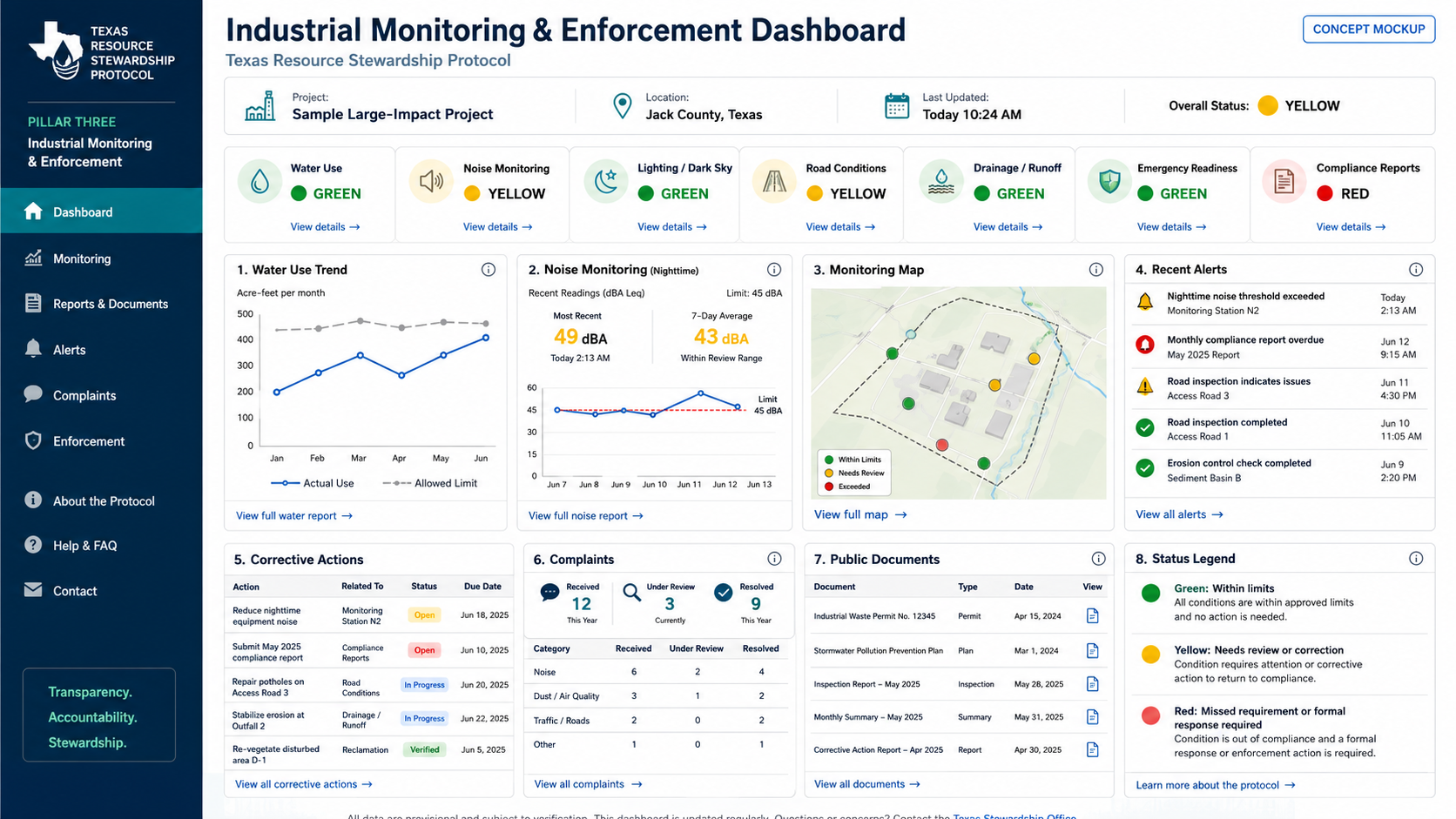
The exact measurements and layout would vary by project, but every displayed status should connect to the underlying evidence, applicable standard and required response.
The public should be able to see:
- The standards and commitments being monitored.
- The current status of each requirement.
- Recent trends and significant changes.
- Missed reports or unavailable data.
- Open complaints and verified incidents.
- Required corrective actions.
- Whether the corrective action has been completed and verified.
- Links to the underlying public reports and findings.
The operator should be able to explain the data.
County officials and independent reviewers should be able to trace the dashboard back to the underlying record.
Residents should be able to understand the basic status without becoming technical specialists.
Green, Yellow and Red status
A simple status system can give the public a starting point.
- Green means the project is operating within the applicable standard or commitment.
- Yellow means a threshold, trend, complaint, reporting gap or equipment problem requires review and timely correction.
- Red means a material limit, commitment or corrective-action requirement has been missed and formal response is required.
The color does not replace the evidence.
A green symbol should link to the records supporting that status.
A yellow status should explain what is being reviewed, who is responsible and when an update is due.
A red status should identify the missed requirement, immediate response and next enforcement step.
The dashboard should show the work, not simply announce a conclusion.
From alert to verified resolution
Monitoring is useful only when the information leads to action.
The response process should be established before a problem occurs.
A practical pathway should include:
1. Detection or complaint
An automated monitor, required report, inspection or public complaint identifies a possible problem.
2. Acknowledgment and initial review
The operator and designated public officials receive notice. The system records when the alert was received and who is responsible for the first response.
3. Verification
The condition is checked against the applicable standard, equipment status and supporting evidence. Independent testing may be required when the facts are disputed or the impact is material.
4. Corrective action
The operator addresses the cause, limits the impact and completes the correction required by the agreement or governing authority.
5. Retesting and confirmation
The project must show that the correction worked. A repair is not closed merely because the operator reports that work was performed.
6. Public closure or escalation
The public record explains what happened, what was corrected and how the result was verified. An unresolved, repeated or serious problem moves to the next enforcement step.
This process gives responsible operators a fair opportunity to correct problems.
It also prevents complaints and out-of-limit events from disappearing into an informal conversation with no final record.
A clear complaint process
Residents often notice conditions that automated systems do not capture.
A complaint process should make it easy to report a concern without requiring the resident to know which office, agreement or technical standard applies.
The system should record:
- When the complaint was received.
- The location, time and condition reported.
- Whether supporting photographs, recordings or other evidence were provided.
- Who acknowledged and investigated it.
- What testing or site review occurred.
- Whether the complaint was verified.
- What correction was required.
- When the matter was closed or escalated.
A complaint is not proof by itself.
It is also not something to dismiss without review.
The purpose of the process is to convert a reported condition into a documented finding.
Local alerts and verification
Out-of-limit events should be routed to the officials and technical reviewers designated by law, agreement or county procedure.
The alert pathway should identify:
- Who receives the first notice.
- Who verifies the local condition.
- Who reviews the technical data.
- Who may require or confirm corrective action.
- Who communicates the status to the public.
- Who has authority to take an enforcement step.
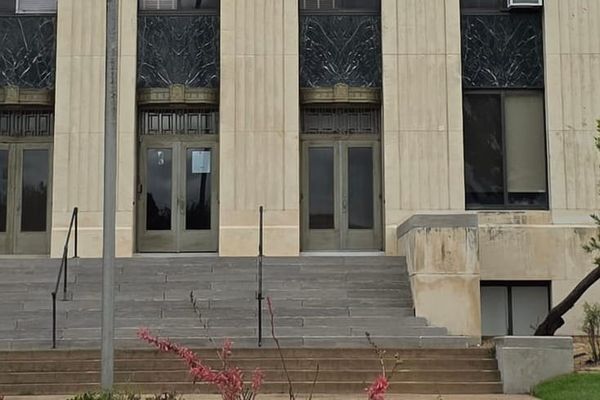
This may include notification to the Constable's office where the Legislature provides authority and local verification, documentation or response is appropriate.
Constables are county officers with a local presence. Under a properly defined legislative framework, they could help document conditions, preserve evidence, confirm that required notices were delivered or perform other duties clearly assigned by law.
They should not be expected to act as engineers, hydrologists or noise specialists.
Technical findings should remain with qualified reviewers.
The local officer's role should be clearly defined, trained, funded and connected to the public record.
Data quality matters
A dashboard is only as trustworthy as the information behind it.
The monitoring framework should establish rules for:
- Equipment accuracy and calibration.
- Monitor location and installation.
- Data collection intervals.
- Missing or interrupted data.
- Record retention.
- Independent access and auditing.
- Correction of inaccurate records.
- Cybersecurity and protected information.
- Operator certifications.
- Public access to nonprotected information.
A project should not be able to declare compliance by choosing a monitor location that avoids the affected area or by treating missing data as proof that nothing happened.
The monitoring plan should be reviewed before operations begin and updated when equipment, operating conditions or known impacts change.
Independent and funded oversight
Monitoring should not become an unfunded burden on a small county.
Project agreements and future legislation should support applicant-funded monitoring equipment, data systems, qualified reviewers, inspections and corrective-action verification.
Applicant-funded does not mean applicant-controlled.
The county or another authorized public body should select and direct independent reviewers when independent review is required.
The project should fund the reasonable monitoring costs associated with its operations.
This is not an unfamiliar expectation. Industrial facilities already pay for fire alarms, hazardous-gas detectors and monitoring systems needed to identify risks created by their operations. Those systems do more than collect data. They notify operations when a threshold is crossed and activate a defined response.
Large-impact project monitoring should follow the same principle. The project should fund the equipment, data systems and trained operational response needed to detect and address conditions tied to its own activities. County officials and public responders should receive the alerts and records needed for independent verification, oversight and escalation when a condition affects neighboring property, public infrastructure or community safety.
The cost belongs with the operation creating the need, not with the county or its taxpayers.
The reviewer should remain responsible to the public process.
That separation helps responsible developers demonstrate compliance while preserving confidence in the result.
Enforcement should be defined before it is needed
Enforcement does not have to begin with the harshest response.
It should begin with a clear sequence that distinguishes a correctable issue from a serious, repeated or intentional failure.
Depending on lawful authority and the enforceable agreements in place, the response may include:
- A written notice of deficiency.
- A required cure plan and deadline.
- Independent testing or inspection.
- Temporary operating limits while a condition is corrected.
- Use of financial assurance for required repair or mitigation.
- Agreement remedies or loss of discretionary benefits.
- Referral to the state agency or public body with jurisdiction.
- Civil enforcement or another legal remedy where authorized.
- Emergency action when an immediate threat falls within lawful county or state authority.
The sequence should be predictable, but it should not be rigid when public safety requires a faster response.
Every enforcement action should identify the standard, evidence, responsible party, required correction and consequence for continued noncompliance.
Material changes need review
A project may change after approval.
- Equipment can be added.
- Water demand can increase.
- Operating hours can expand.
- Ownership can change.
New infrastructure can create impacts that were not part of the original review.
The monitoring system should identify material changes and connect them back to the review process.
A material change should not be treated as automatically covered by evidence submitted for a different project design.
The county or other authorized body should determine whether the existing monitoring plan remains adequate, new conditions are needed or supplemental review is required.
What responsible operators gain
Industrial Monitoring and Enforcement is not built on the assumption that every operator will fail.
It gives responsible operators a credible way to show that they are doing what they agreed to do.
A transparent system can:
- Resolve complaints with evidence.
- Identify small problems before they become larger.
- Show that the project remains within agreed limits.
- Protect the operator from unsupported claims.
- Create a consistent record for county officials, lenders, insurers and future owners.
- Demonstrate whether corrective action worked.
Accountability should not be understood only as punishment.
It is also how responsible performance becomes visible.
How the three pillars connect
The Good Neighbor Policy sets the local standards and review process.
The Texas Resource Stewardship Initiative provides the statewide authority, support and common framework needed to apply them.
Industrial Monitoring and Enforcement verifies performance and addresses missed commitments after approval.
Set the standards.
Provide the authority.
Verify the results.
Pillar One determines what the project is expected to do.
Pillar Two provides the authority and support needed to make those expectations meaningful.
Pillar Three creates the continuing record that shows what happened.
Without monitoring, an agreement can become a collection of promises that no one checks.
Without correction and enforcement, monitoring can become a collection of data that changes nothing.
TRSP connects the promise, the evidence and the response.
What Pillar Three does not do
Industrial Monitoring and Enforcement does not require every project to install every possible monitor.
It does not make every complaint a violation.
It does not replace state agencies, courts, municipalities, groundwater conservation districts or other public bodies with existing jurisdiction.
It does not authorize county officers to exercise powers the Legislature has not granted.
It creates a framework for matching oversight to project risk, turning enforceable commitments into measurable requirements and documenting what happens when those requirements are missed.
The goal is not permanent conflict between a project and its neighbors.
The goal is a trusted process that identifies problems, verifies facts and produces correction so large-impact projects can operate as good neighbors to the communities around them.
A working policy proposal
Industrial Monitoring and Enforcement is an active policy-development project.
Its monitoring standards, alert pathways, data rules and enforcement concepts remain subject to legal, technical, county, developer, public and legislative review.
Publication does not mean the framework has been enacted by the Legislature, adopted by a county or approved as final legal language.
The purpose of publishing it is to make the proposal understandable enough for Texans to examine, improve and carry into the legislative process.
Continue exploring
Explore Industrial Monitoring and Enforcement:
https://www.skewthefuture.com/industrial-monitoring-enforcement/
Read Pillar Two: The Texas Resource Stewardship Initiative:
https://www.skewthefuture.com/pillar-two-texas-resource-stewardship-initiative/
Read the Good Neighbor Policy article:
https://www.skewthefuture.com/good-neighbor-policy-local-standards-before-public-support/
Return to TRSP in Plain Language:
https://www.skewthefuture.com/the-texas-resource-stewardship-protocol-in-plain-language/
A question for the Front Porch
After a large-impact project is approved, what information should the public be able to see and what should happen when the project misses a measurable commitment?
Join the conversation in The Front Porch on Facebook.
Let's keep building.
Shared Resources. Shared Standards. Shared Stewardship.