The Texas Resource Stewardship Protocol Is Ready for Review
A practical framework for helping rural Texas communities set clear standards, review large-impact projects and hold approved projects accountable.

We have built enough to put the framework in front of people.
Not because every sentence is finished.
Not because every legal question has been settled.
Not because the work is done.
We are ready because the main structure now exists, the public can see how the pieces fit together and there is enough substance for people to question it, test it and help improve it.
That structure is the Texas Resource Stewardship Protocol.
The Texas Resource Stewardship Protocol is a practical framework for helping rural Texas communities prepare for large-impact projects before the pressure of a final vote, tax-abatement request or development agreement begins driving the process.
It starts with a basic idea:
Responsible growth should be supported by clear standards, reliable evidence and public accountability.
The framework has three pillars.
Pillar One: The Good Neighbor Policy
The Good Neighbor Policy gives counties a local framework for identifying expectations before discretionary public support is granted.
It addresses questions involving water, roads, noise, lighting, emergency response, neighboring properties and long-term accountability.
It also establishes a Large-Impact Project Review process so applications, studies, public comments and proposed agreements are organized into one public record.
Pillar Two: The Texas Resource Stewardship Initiative
The Texas Resource Stewardship Initiative addresses the statewide gaps that counties cannot solve through local policy alone.
It proposes clearer standards and practical authority for counties reviewing large-impact projects.
That includes questions involving groundwater protection, technical review, public costs and the ability of counties to reach a meaningful decision before granting public support.
Pillar Three: Industrial Monitoring and Enforcement
Approval should not be the end of public oversight.
Industrial Monitoring and Enforcement connects project commitments to ongoing monitoring, public reporting, correction and enforcement.
The purpose is to make sure that the standards used to gain approval remain meaningful during construction, startup and operation.
How the review reaches a decision
Collecting information is not enough.
A complete review process must determine whether the evidence shows that the project meets the applicable standards.
The Large-Impact Project Standards and Conformance Review provides four possible findings:
- Conforms
- Conditionally conforms
- Has not demonstrated conformance
- Does not conform
When a problem can be corrected, the applicant receives a written opportunity to provide additional evidence, testing, redesign or enforceable mitigation.
When the record is incomplete, final action should wait.
When a project does not meet the standards, discretionary public support should be withheld unless the deficiencies are corrected.
That is the working principle behind the entire framework:
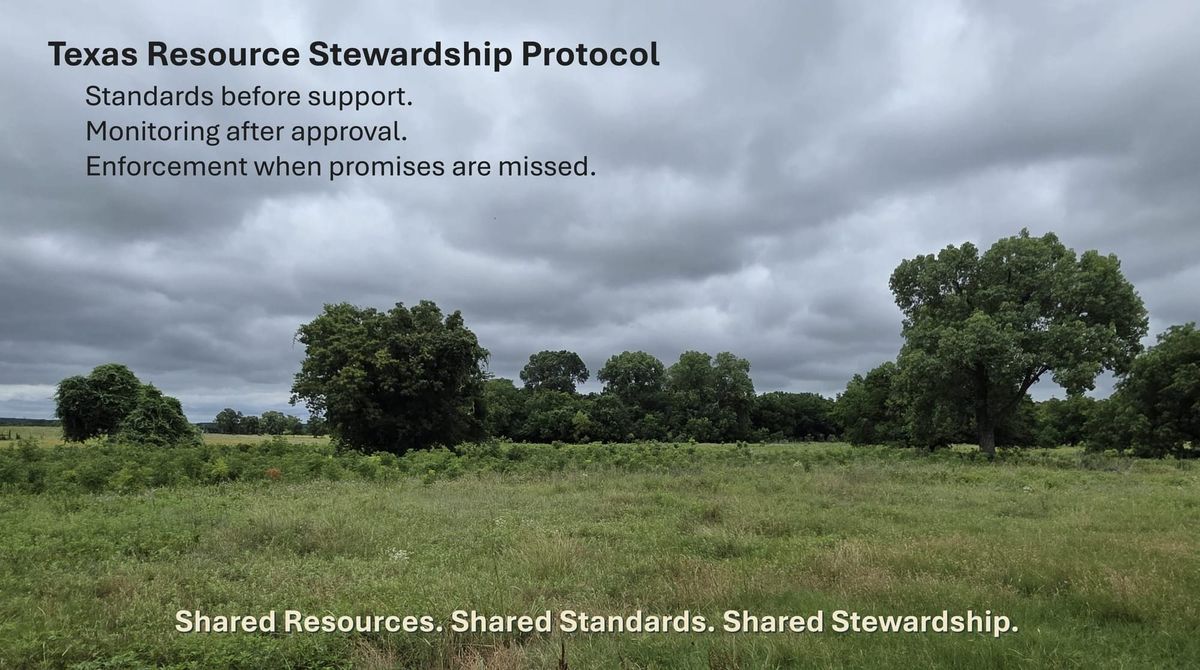
Standards before support.
Monitoring after approval.
Enforcement when promises are missed.
Built for review, not presented as final law
The Texas Resource Stewardship Protocol is an active policy-development framework.
It has not been enacted by the Texas Legislature, adopted by a county or approved as final legal language.
That is why this next stage matters.
The framework now needs review from rural residents, county officials, technical professionals, responsible developers, legislators and community leaders.
The goal is not to ask everyone to endorse every sentence.
The goal is to find out:
- What works?
- What is missing?
- What needs to be clearer, stronger or more practical?
Start here
- Texas Resource Stewardship Protocol
- Good Neighbor Policy
- Large-Impact Project Review
- Large-Impact Project Standards and Conformance Review
- Texas Resource Stewardship Initiative
- Industrial Monitoring and Enforcement
Downloadable summaries, review tools and supporting documents are available in the Resource Library.
Creating an account is free. No payment is required.
The website is built.
The framework is visible.
Now it is time to put it in front of people who can question it, improve it and eventually implement it.
Let’s keep building.
Shared Resources. Shared Standards. Shared Stewardship.